

Open Head Pail
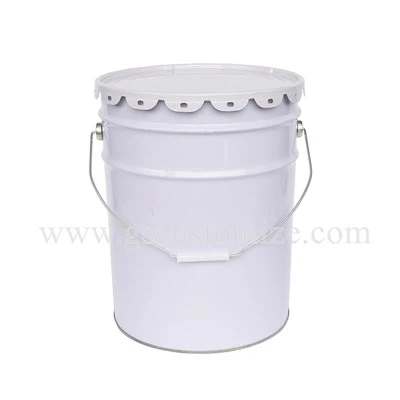
Open head pail is a type of metal container made from thin sheets of tin-coated steel. It is commonly used for holding paints, chemicals, and other viscous liquids. Open head pail are designed to be lightweight, durable, and corrosion-resistant. They come in various sizes and shapes and can be manufactured with a range of features such as fold-over handles, pouring spouts, and removable lids. Open head pail are widely used in the industrial, agricultural, and construction sectors, as well as in households for storage and transport of liquids. They are considered a cost-effective and eco-friendly alternative to plastic containers due to their recyclability and long lifespan.
Advantages of Open Head Pail
Sterility
It’s easy to sanitize and sterilize metal open head pail. You can heat aluminum and steel to temperatures that are hot enough to kill bacteria and other germs. Metal is also non-porous, meaning there aren’t small crevices on its surface where germs can hide.
Sustainability
Most types of metal open head pail are easily recycled. Aluminum and steel are two of the most recycled materials in the world, and rates of recycling are high for each one. Instead of having to extract new metal from the earth, most companies that use metal packaging use materials that are at least partially recycled.
Size range
Another reason you might use metal open head pail is that many different options are available to you. Metal packages come in a wide range of sizes and forms. Beverage cans can range in size from six to 20 ounces, for example. Metal cans used to package food can be eight ounces, 15.5-ounces or 28-ounces. Aerosol cans, paint cans and metal tubes are also available in a broad range of sizes.
Safety
Since metal open head pail is easily sterilized and non-porous, it is safe for use with food. There is a chance that certain types of metal can leach into certain types of products, such as aluminum leaching into acidic foods. But that can easily be prevented by lining the metal with a coating.


Customized services
We are good at customization. All our factories have decades of producing experience and professional engineers, cooperating with our patient and meticulous trade team, we will provide high-quality products and service to you, especially designing and producing according to your demand.
Technology
Experienced engineers provide you professional suggestions, designs and services.
Experience
International business staffs of over 15 years of experience and factories of 3 decades of production.
Our factory
We are located in zibo which is a traditional industrial city in north china with 39 among 41 divisions of the second industry in industry classification of national economy of china which covers the entire relative divisions of international standard industrial classification of all economic activities.
7 Ingenious Uses for a Open Head Pail
Cleaning saw blades
A great way to clean your saw is to soak it in a turpentine solution in a shallow pail, with a lid on to minimise the chance of fumes escaping. You can 'shallow-ise' a plastic five gallon pail by chopping the bottom two inches or so off a with a knife or saw. You can use the pail's lid as a cover. As a precaution, always wear gloves and use some sort of stick to yank out the blades.
A makeshift lobster pot
People often use large kettles or pans if they're lucky enough to be cooking lobster for tea. However, if you don’t have either, you can use a metal pail to do this. Again, use gloves when handling the bucket and tongs while cooking or removing the lobster. Always leave the metal pail to cool before picking it up.
Food locker
Another use for a open head steel pail with lid is to make a waterproof food locker to bring with you on camping holidays. It needs to be a tightly sealed pail so ensure you buy a high quality one.
Painting and decorating
If you're decorating on a ladder, it can be all too easy to spill paint. If you put the tin of pain inside a large bucket it helps avoid this. If you have a large, heavy duty bucket, you can fit inside your brush, scraper and a knife, or any other tools you use. If you're off the ladder and painting below, you can also put the lids to good use as trays for your pain tins. This will again help prevent paint spilling onto the floor.
Tidy extension cables
That five gallon bucket can be used to keep an extension cable tangle-free. You just need to drill a hole near to the bottom of the bucket, ensuring it's big enough for the end of the cord to go through. Once you've done that, coil the remaining lead into the pail. The cable should come out easily when you pull it and also be very easy when you want to coil it back in. You can just plug the cable ends together when you're not using it. You could also make use of the centre area to transport tools in.
Miniature garden
You can use a open head steel pailto create a planter or miniature garden. If you have more than one spare bucket, use one to compost your scraps and cuttings. A great place to put miniature gardens is on the balcony if you live in a flat.
Christmas tree stand
Yes, it's already time to start talking about christmas and you can be ultra-prepared for the arrival of your tree buy making this easy stand. Partially fill a pail with some sand or even gravel and pop the base of the christmas tree in. Once inserted properly, just top it ip. Once sturdy, ensure you water it to prevent the tree drying out.
How to Pick the Right Liner for Open Head Pail
Size of the Container and Construction Materials
The size of your container and the materials it is constructed of will be important factors in choosing the right liner for your container.
Interestingly enough, if you are using pails and the pail is steel, you don’t need to measure it because all steel pails are manufactured of the same size. If your container is plastic, you will need to measure its height.
Drums will generally be made of steel, plastic, or fiber materials and come in a variety of sizes. To ensure the proper fit of your liner, you will need to measure the height and diameter of the drum. The height of new drums is typically 34.25” and a standard 55-gallon liner will work. If a steel drum is reconditioned, however, the best options are either an accordion or combination liner. A combination liner (CBN) combines the straight-sided design with a band of accordion pleats to accommodate both drum height and variations in the drum’s interior. Accordion liners have pleated side walls that accommodate variations in reconditioned drum heights.


The Type of Materials Being Stored
Another key element in choosing drum or pail liners is whether or not the type of material being stored has specific material or barrier requirements. Some examples of materials available and their typical uses include:
High-density polyethylene liners (HDPE). These liners are rigid and durable. They are robust enough for a wide range of applications and have superior solvent resistance.
Low-density polyethylene liners (LDPE). These are general-use liners. They provide superb tensile strength and elongation, as well as high resistance to tears and flex cracking. This liner is designed for applications of up to 175 degrees F.
Anti-stat liners. These specific liners contain an internal agent to aid in the reduction of static build-up. This reduces dry chemical static cling and the chance of ignition of flammable materials.
Conductive liners. Made from conductive plastic, these liners are engineered to absorb an electrical charge and move it safely to ground.
High barrier foil. This is superior in providing a high oxygen and water vapor barrier and is constructed of sides made from a lamination of polypropylene-aluminum foil-polyethylene with the bottom constructed using a polyethylene-foil-polyester lamination.
Durability Requirements
There are a variety of options for pail and drum liners depending on durability needs. CDF’s heat seal technology is used to produce a flat seam and round bottom liners, such as our acclaimed LinerPro™ series. CDF’s proprietary impulse heat seal equipment enables us to seal polyethylene products, as well as difficult-to-seal specialty films, including:
Metalized polyester and foil laminates for moisture protection
Conductive laminates and anti-static films for volatile materials
Nylon and co-extruded films for chemical resistance
Polypropylene for high-temperature requirements
Low-density polyethylene for general use

The Use Of Open Head Steel Pail
Steel Buckets can be used to load a variety of liquid and solids. The more common ones are cylindrical ones. The bottom is closed with an iron sheet. There is an iron handle on the top. It is very convenient and quick to carry around. Another type of iron barrel has only a small opening at the top and the bottom of the barrel is closed. It is generally used for oil transportation. The iron drum is not easy to break, rust, light weight, etc., and has excellent oil resistance and strong corrosion resistance.
Can be used as hot filling, generally the temperature should not exceed 60℃. After hot filling, the lids and stacking should not be tightly closed until the contents have cooled down sufficiently to reach room temperature. Excellent weather resistance at 50°C above zero - 40℃ below zero. Iron barrels can be used for a long time, are not afraid of water flushing, are not afraid of fire, are not affected by the environment, cannot be damaged or deformed, are very suitable for holding liquids, and are often used for oil transportation. The main feature is that it is very strong and durable, has a very long service life, and can hold any items without being affected by various harsh environments. It can be used as an item to hold or transport around.
The Manufacturing Process of Open Head Pail
Open head pail have become an integral part of our daily lives, serving as containers for various products ranging from food and beverages to industrial goods. Understanding the manufacturing process behind these pails can provide valuable insights into the intricate steps involved in their production.
The manufacturing process of open head pail typically begins with the selection of suitable materials. Steel is the primary metals used due to their durability, strength, and recyclability. These metals undergo a series of transformations to become the sturdy pails we encounter in stores.
The first step is metal preparation. The chosen metal is processed into sheets or coils, ensuring uniform thickness and quality. These sheets serve as the foundation for the subsequent stages of pails production.
Once the pails are shaped, they go through the printing and decoration stage. Graphics, branding elements, and labelling are applied to the pails to enhance their visual appeal and provide vital product information.
Sealing the pails and attaching the lids or ends comes next. The pails are carefully sealed to ensure an airtight and secure enclosure for the contents. Seaming, a common technique in can manufacturing, involves mechanically folding and interlocking the can body with the lid or end, providing a reliable seal.
Throughout the manufacturing process, quality control measures are implemented to maintain the integrity and safety of the pails. Inspections, testing procedures, and adherence to stringent regulatory standards help identify and rectify any potential defects or issues, ensuring that the final product meets the highest quality standards.
By gaining insights into the manufacturing process of open head pail, we can appreciate the meticulous craftsmanship and precision involved in their creation. From material selection to shaping, printing, sealing, and quality control, each step contributes to producing pails that are not only functional but also visually appealing and reliable.
Open Head Steel Pail Volume Confirmation
1. If the user fills the liquid, it is calculated according to the specific gravity (density) of the product, but there must be enough space for 10% of the expansion and cracking of the product to prevent the steel drum from deforming and cracking during handling or falling.
2. If the user holds solids, he can request the steel drum manufacturer to provide steel drums of the same volume for trial installation, and then calculate the required volume of steel drums for the loading weight. However, 5%-10% of the space should also be reserved for the wrapping of the plastic inner bag to prevent the steel drum from falling and deforming during transportation, cracking, and flying lid.
3. If the user fills products with low boiling points (generally below 60), it is necessary to fully consider that such products have vapor pressure at a certain temperature, and the liquid vapor pressure increases with the increase of temperature. In addition, it is necessary to consider the product filling temperature and the maximum temperature that the steel drum may encounter during storage and transportation after filling. Generally, 55 should be considered. In some areas, a temperature difference of 60 as high as 60 should be considered, which will cause product expansion and lead to steel drums. Generate internal pressure, and the sum of these two pressures cannot be greater than the allowable internal pressure pressure in the steel drum. Otherwise, the steel drum will burst and be severely deformed.
4.If the user fills the product with a high temperature, cool the product to room temperature as much as possible before filling. If the product cannot be cooled and needs to be filled, the filled steel drum cannot be tightened immediately, otherwise the temperature difference will cause The negative pressure generated by the steel drum causes the steel drum to deflate or deflate as soon as it touches the steel drum.
(1) Restrictions on raw materials for steel drums To make steel drums, the material must have low carbon content and good plasticity. Because of its good processing performance, welding, stamping, and bulging are easy to ensure quality. But the hemming is different, because the size of the hemming roller groove cannot change with the hemming process, and the hemming force must be gradually transferred to the center of the hemming through the peripheral material, so that the center can be rolled. The better the plasticity of the material, the more difficult it is to transmit force. It is conceivable that if the material of the steel drum is spring steel, the same material as the law of a clock, not to mention rolling ten layers, I am afraid it is also easy to roll 20 layers, because it has good elasticity and rigidity, and the sealing force is very high through the outer volume. Easy to reach the center. But this is impossible, because this material has good elasticity, so after the end of the rolling, when the rolling force disappears, it is easy to rebound back to the original state, that is, to return to the beginning of the rolling. This is obviously not what we need. Therefore, it is impossible for us to choose highly elastic materials. In terms of the materials currently used to make steel drums in the world, our country has the most rigid materials, so the quality is more difficult to guarantee. And the number of curling layers does not exceed seven.
(2) The limitation of the steel drum coil sealing technology. At present, the most advanced coil sealing technology in the world is similar, except for the change of the crimping roll profile and the difference of the coil sealing speed. This process method is the most economical method for mass production, and it is also the method with the lowest quality cost. If you don't care about these, there may be a better way to transmit the sealing force farther, so that the curling can reach more than seven layers. But for steel drums, a good seven-layer crimp is enough. If the current quality of the crimp is not good, you need to find other problems.
FAQ
We're professional open head pail manufacturers and suppliers in China, specialized in providing high quality products and service. We warmly welcome you to buy high-grade open head pail from our factory. For more information, contact us now.
Round Metal Pails, custom pail, Tinplate Pails